The 7 Mukhi Rudraksha meaning goes well beyond the number seven — it is a convergence of deity, planet, sacred text, and spiritual symbolism that makes this bead one of the most layered in the Rudraksha tradition. Governed by Goddess Mahalakshmi and the planet Saturn (Shani), the seven-faced bead carries traditional associations with wealth, discipline, spiritual growth, and karmic resolution that have made it a significant object of devotion across Sanatan Dharma practice for centuries.
What Is a 7 Mukhi Rudraksha?
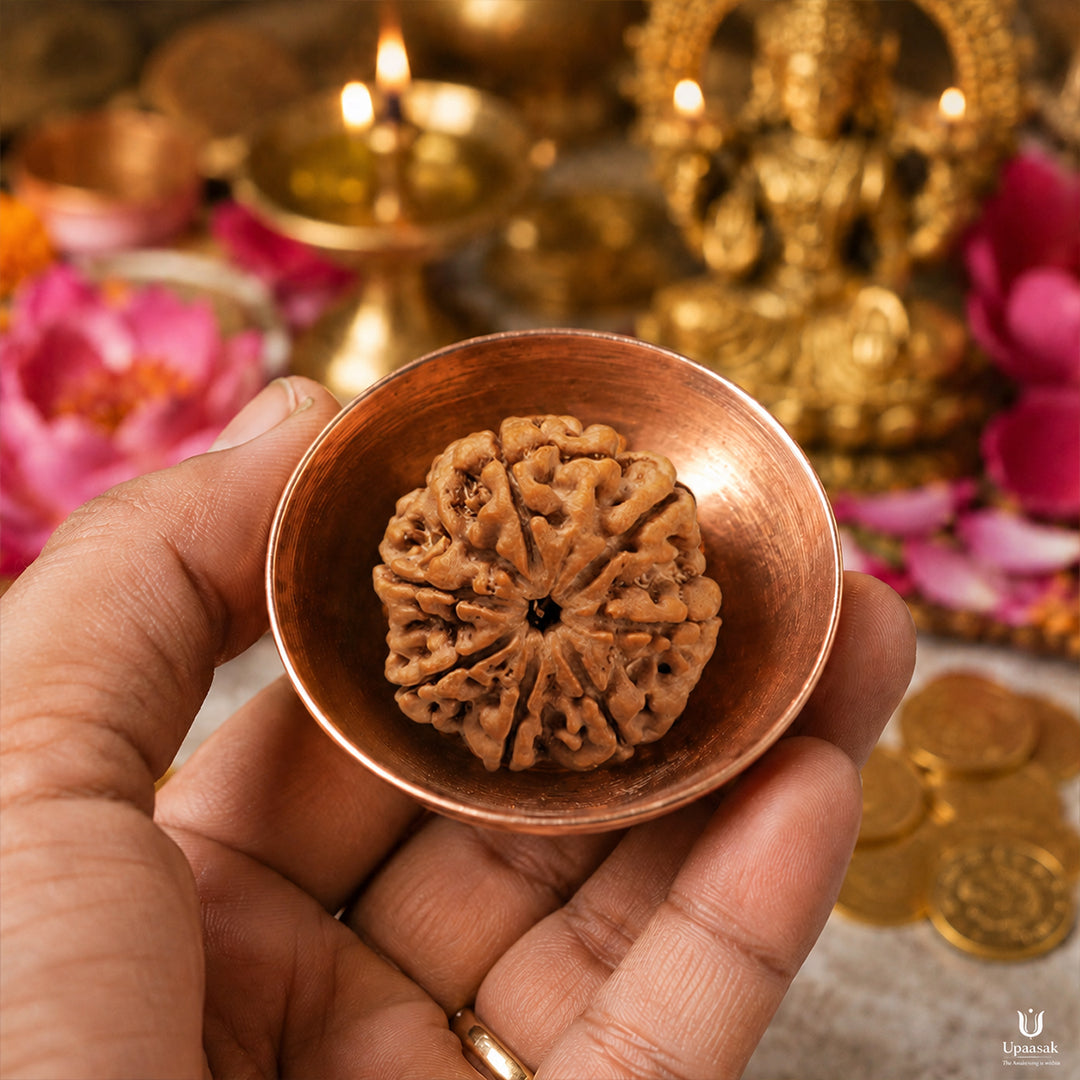
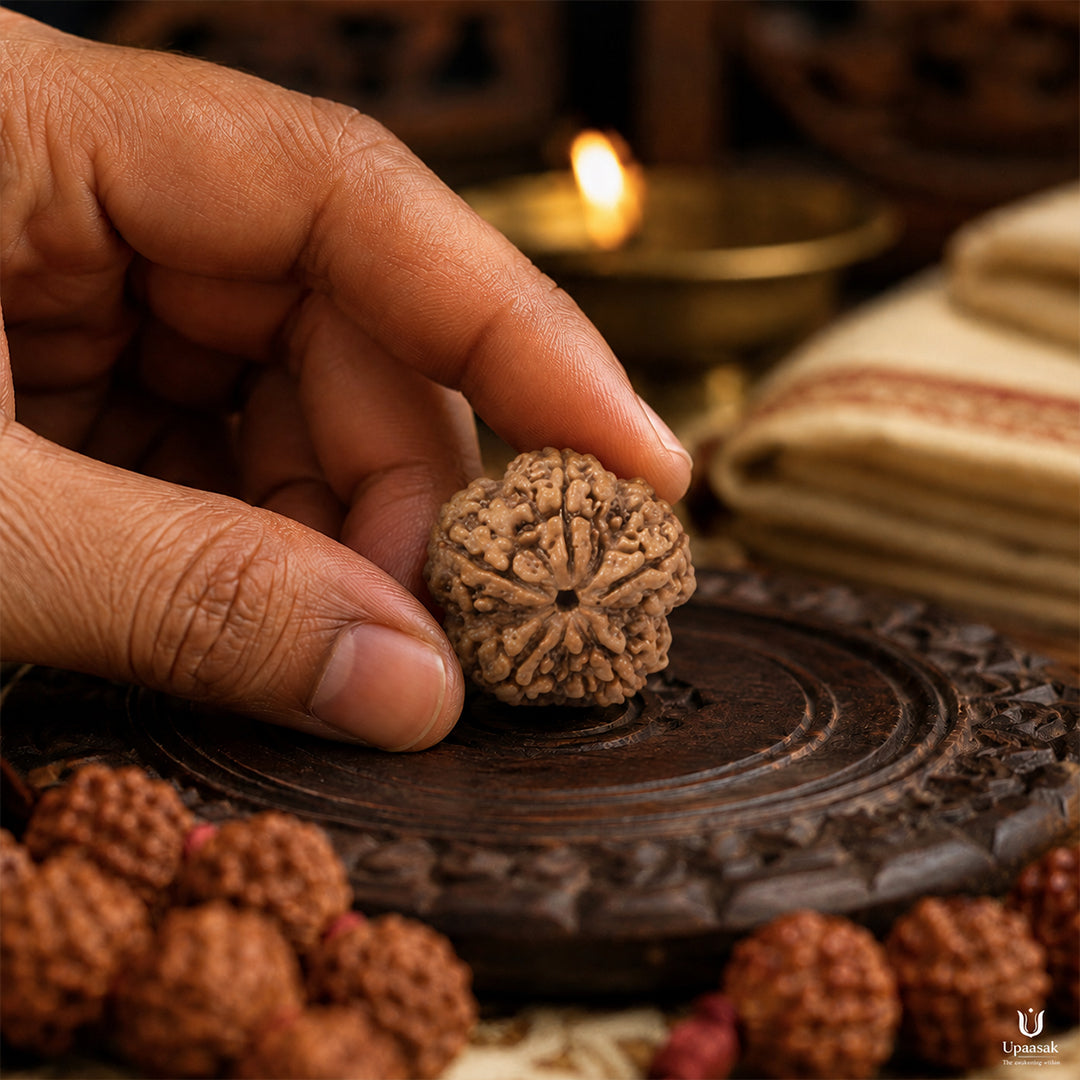
A 7 Mukhi Rudraksha is a Rudraksha bead with seven naturally formed faces — linear grooves that run from the top (stem end) to the base of the bead. These mukhis form naturally as the bead grows on the Elaeocarpus ganitrus tree, which grows primarily in the Himalayan regions of Nepal and parts of India and Indonesia.
The number seven holds profound significance in Hindu cosmology — it corresponds to the Sapta Lokas (seven realms), the Sapta Rishis (seven sages), the seven notes of music (saptaswara), and the seven chakras of the human subtle body. A bead with seven faces therefore carries layered symbolic resonance across multiple dimensions of Hindu tradition.
The natural 7 Mukhi Nepali Rudraksha from Upaasak is sourced from Nepal — the most respected origin for high-quality Rudraksha beads with well-defined natural mukhis.
Meaning of Seven Mukhi
Each mukhi in a Rudraksha represents a face — and according to the Shiva Purana and Padma Purana, each face is associated with a specific deity or divine manifestation. The seven mukhis of this bead are traditionally associated with the Sapta Matrikas — the seven divine mothers of Hindu tradition — alongside individual associations with Mahalakshmi and Ananga (a form associated with divine beauty and abundance).
The 7 Mukhi Rudraksha meaning in practice is: a bead that carries the grace of seven divine presences, with particular emphasis on the prosperity goddess Mahalakshmi.
Goddess Mahalakshmi Association
The primary deity associated with the 7 Mukhi Rudraksha is Goddess Mahalakshmi — the goddess of wealth, fortune, beauty, and prosperity in the Hindu pantheon. According to the Shiva Purana, the seven-faced bead is described as "Ananga" — connected to Mahalakshmi's grace — and wearing it is believed to invite her blessings for material abundance and spiritual richness.
This association makes the 7 Mukhi Rudraksha meaning particularly significant for those seeking financial prosperity, business success, and material stability through spiritual practice and devotion.
Shani / Saturn Association
In Vedic astrology, the 7 Mukhi Rudraksha is governed by Saturn (Shani) — the planet of karma, discipline, justice, and long-term consequences. This planetary association adds a second layer to the bead's meaning:
- Saturn governs hard work, perseverance, and earned results
- Its influence is associated with lessons around responsibility, patience, and discipline
- Wearing the 7 Mukhi during Saturn-related astrological periods (Sade Sati, Shani Mahadasha) is a traditional practice for seeking karmic relief
- The combination of Mahalakshmi (abundance) and Saturn (discipline) creates a uniquely balanced traditional framework — prosperity through earned, disciplined effort
Sapta Matrikas & Traditional References
The Sapta Matrikas are seven divine mother goddesses mentioned in the Devi Mahatmya and various Puranas: Brahmani, Vaishnavi, Maheshwari, Indrani, Kaumari, Varahi, and Chamunda (or Narasimhi in some traditions). Some traditions associate each of the seven mukhis with one of these seven divine mothers, lending the bead a protective and nurturing spiritual quality alongside its prosperity associations.
Explore the full Rudraksha collection for other mukhi varieties and their respective deity and planetary associations.
Spiritual Significance
The 7 Mukhi Rudraksha meaning in spiritual practice encompasses:
- A sacred bridge between worldly aspiration (wealth) and spiritual discipline (Saturn's lessons)
- A focal object for Mahalakshmi devotion and Shiva worship
- A bead used in Rudraksha Diksha (initiation into Rudraksha wearing) for prosperity-seeking devotees
- A meditation object that is believed to activate the Ajna (third eye) and Sahasrara (crown) chakras in some traditions
Why It Is Associated With Wealth and Discipline
The pairing of Mahalakshmi and Saturn in the 7 Mukhi Rudraksha meaning is not contradictory — it is philosophically coherent. In the Sanatan Dharma worldview, true and lasting prosperity comes not from luck alone but from disciplined effort blessed by divine grace. Mahalakshmi bestows the grace; Saturn governs the discipline. The seven-faced bead holds both in a single sacred object.
This is why it is particularly recommended in tradition for business owners, professionals navigating career challenges, and devotees facing Saturn's karmic tests — situations where both divine blessing and sustained effort are needed.
FAQ
Which God is 7 Mukhi Rudraksha?
The primary deity associated with 7 Mukhi Rudraksha is Goddess Mahalakshmi, the goddess of wealth and prosperity. In Vedic astrology, the bead is also governed by the planet Saturn (Shani).
Which planet rules 7 Mukhi Rudraksha?
Saturn (Shani) rules the 7 Mukhi Rudraksha according to Vedic astrological tradition. Its influence relates to karma, discipline, hard work, and long-term outcomes.
What does 7 Mukhi Rudraksha symbolize?
It symbolises the union of divine abundance (Mahalakshmi's grace) and karmic discipline (Saturn's lessons) — representing prosperity achieved through sustained, righteous effort.
Why is 7 Mukhi associated with Shani?
In Vedic astrology, seven is Saturn's number — the seventh planet in the traditional planetary order. The seven-faced bead is therefore traditionally assigned to Saturn, and wearing it is believed to harmonise Saturn's influence in the wearer's horoscope.