Rudraksha certification is the most reliable assurance available to buyers who cannot physically examine a bead before purchasing — and in a market where imitation Rudraksha is widespread, understanding what different certificates actually prove (and what they do not) is essential knowledge for any serious buyer. This guide covers every major certification type, explains what X-ray testing reveals that no visual inspection can, and gives you a practical framework for evaluating any authenticity claim you encounter.
Why Rudraksha Certification Matters
The Indian and global Rudraksha market contains a significant proportion of fake, carved, chemically treated, or misrepresented beads. The problem is not niche — it is widespread across online marketplaces, local shops, pilgrimage sites, and even reputable-looking jewellery brands. Common issues include:
- Carved wood seeds sold as natural Rudraksha
- Lower-mukhi beads artificially carved to appear as higher-mukhi varieties
- Genuine Rudraksha seeds heavily lacquered or chemically treated and sold as premium natural beads
- Indonesian-origin beads sold as the more valuable Nepali-origin Rudraksha
- Plastic or resin moulded beads sold as natural seeds at tourist sites
In this environment, Rudraksha certification from a credible third party is not a luxury — it is the most practical protection a buyer has when physical examination is impossible, which describes virtually every online purchase.
What Is Rudraksha Certification?
Rudraksha certification is a document issued by a testing laboratory, gemological institution, or qualified authority that provides independent verification of specific properties of a Rudraksha bead. Depending on the type of certification and the testing method used, a certificate can confirm:
- That the bead is a genuine Elaeocarpus ganitrus seed — not wood, plastic, or resin
- The number of natural mukhis (faces) present on the bead
- Whether the mukhis are naturally formed or artificially carved
- The geographic origin of the bead (Nepal, Indonesia, India)
- Physical dimensions and weight
- Whether the bead has been chemically treated or heavily lacquered
What no certificate can confirm:
- The spiritual power or energetic properties of the bead — these are matters of faith and tradition, not laboratory measurement
- That a bead is "blessed" or "energised" — these are seller claims, not testable attributes
Types of Rudraksha Certificates
Not all Rudraksha certificates carry equal weight. Understanding the different types helps you assess what you are actually receiving:
1. Third-Party Gemological Laboratory Certificate
This is the most credible type of Rudraksha certification. Issued by an independent testing laboratory — not the seller — it documents findings from physical and scientific examination of the bead.
What a genuine lab certificate includes:
- Name and address of the issuing laboratory
- A unique certificate number traceable to the testing record
- Date of testing
- Physical description of the bead — dimensions, weight, colour
- Mukhi count as observed
- Finding on whether the bead is natural Rudraksha or an imitation
- Testing method used
- Laboratory seal and authorised signature
Reputable laboratories that test Rudraksha in India include gemological testing centres associated with institutions like the Gem and Jewellery Export Promotion Council (GJEPC) and private accredited labs. The Gemological Institute of America (GIA) does not specifically certify Rudraksha as it does diamonds — so be cautious of GIA references on Rudraksha certificates, as these may be misleading.
2. X-Ray or CT Scan Certificate
X-ray or computed tomography (CT) scanning is the most scientifically definitive Rudraksha certification method available. It reveals the internal structure of the bead — which no visual examination, however careful, can achieve.
This is covered in full detail in the next section.
3. Seller-Issued Certificate
Many sellers provide their own "certificate of authenticity" — a document they produce themselves describing the bead as genuine. This carries no independent verification weight whatsoever. It is a statement, not a credential.
A seller-issued certificate is the least reliable form of Rudraksha certification. Any seller can produce one for any bead, regardless of its actual quality or authenticity.
How to spot a seller-issued certificate:
- The issuing body is the same brand or company selling the bead
- No unique traceable certificate number is present
- No independent laboratory name or contact information appears
- The document is printed on branded stationery with no external verification reference
- There is no way to cross-check or verify the certificate independently
4. Government or Institutional Endorsement Claims
Some sellers claim their Rudraksha is "government certified" or "approved by" a religious institution. These claims require careful scrutiny:
- No Indian government body issues routine Rudraksha certification as a standard consumer product service
- Religious institutions (temples, ashrams, mutts) may provide blessings or endorsements — these are spiritual validations, not scientific authenticity tests
- Any "government certification" claim should come with the specific name of the issuing body and a verifiable document number
X-Ray Testing: The Gold Standard for Rudraksha Certification
X-ray testing is the definitive scientific method for verifying Rudraksha authenticity — and specifically for confirming that a bead's mukhi count is genuine and not artificially carved. Here is exactly how it works and what it reveals.
How X-Ray Testing Works
A Rudraksha bead is placed in an X-ray or CT scanner — the same fundamental technology used in medical and industrial imaging. The scanner passes X-ray radiation through the bead and produces an image of its internal structure.
Because Rudraksha seeds are organic material with a specific internal architecture, the internal image reveals:
- Seed compartments: A genuine Rudraksha bead contains internal chambers — one for each mukhi — divided by natural septa (internal walls). A 5 Mukhi bead has five internal chambers. A 7 Mukhi bead has seven.
- Internal seed structure: The natural seed and embryo structure within the bead is visible and distinctive to Elaeocarpus ganitrus seeds
- Hollowness or foreign material: Imitation beads made of wood, resin, or plastic show no compartmented internal structure — they appear hollow, uniformly dense, or structurally inconsistent with a genuine seed
What X-Ray Proves That Visual Inspection Cannot
The critical limitation of any visual examination — no matter how expert — is that it assesses only the bead's surface. Artificial carving adds lines to the exterior surface of a plain or lower-mukhi bead to make it appear to have a higher mukhi count. A visually convincing fake can pass physical surface examination even by experienced practitioners.
X-ray imaging bypasses the surface entirely. It looks inside the bead and asks: does the internal compartment count match the external mukhi count?
- 5 external mukhis + 5 internal compartments = genuine 5 Mukhi Rudraksha
- 5 external mukhis + 2 internal compartments = artificially carved bead — fake
- 7 external mukhis + 0 internal structure = wood or resin imitation — fake
No carved, moulded, or imitation bead can replicate the specific internal compartmented architecture of a genuine Rudraksha seed. This is why X-ray certification is considered the definitive authentication method.
CT Scan vs Standard X-Ray
Both methods reveal the internal compartment structure, but CT scanning provides more detailed three-dimensional imaging:
| Method | What It Shows | Best For |
|---|---|---|
| Standard X-ray | Internal compartments, basic structure | Confirming mukhi count authenticity |
| CT scan | Full 3D internal architecture, seed detail | High-value beads, detailed documentation |
| Visual inspection alone | Surface mukhis, texture, colour | Initial assessment only — not definitive |
For everyday 5 Mukhi bracelet beads, standard X-ray testing provides sufficient confirmation. For rare or high-value beads — 1 Mukhi, 14 Mukhi, Gauri Shankar — CT scanning provides more comprehensive documentation.
Real vs Fake Rudraksha: What Each Test Reveals
Understanding what different examination methods can and cannot confirm helps you build a complete picture:
| Test Method | Confirms | Cannot Confirm |
|---|---|---|
| Visual surface inspection | Surface mukhis, texture, pores, colour | Internal compartment count — definitively |
| Weight and density check | Approximate material density | Specific species identification |
| Water flotation test | Very rough density indication | Almost nothing reliably — not recommended as a sole test |
| Copper coin test | Nothing scientifically — a folk test with no verified basis | Everything — this test is unreliable |
| Standard X-ray | Internal compartment count = mukhi verification | Geographic origin specifically |
| CT scan | Full internal architecture, seed structure | Spiritual properties |
| Lab certificate (third party) | Species identification, natural vs imitation, mukhi count | Future durability or spiritual efficacy |
The Water Test: Why It Is Not Reliable
The water flotation test — where a genuine Rudraksha supposedly sinks while a fake floats — is one of the most widely cited home tests and one of the least reliable. Here is why:
- Dense fake beads made of resin or heavy wood also sink
- Small genuine Rudraksha beads with natural air pockets may float
- A lacquered genuine bead may behave differently in water than an unlacquered one
- The test result depends on bead size, density, and surface treatment — not authenticity alone
Do not rely on the water test as a primary or sole authenticity check. It can only indicate an obviously hollow or very lightweight fake — it cannot confirm a genuine bead.
The Copper Coin Test: No Scientific Basis
The test where a Rudraksha placed between two copper coins is supposed to rotate due to "electromagnetic energy" has no scientific basis whatsoever. No peer-reviewed study supports this as an authenticity test. Avoid it entirely.
Visual Signs of Real vs Fake Rudraksha
While X-ray is definitive, visual examination remains a useful first step and can flag obvious imitations before pursuing formal testing:
Signs of a genuine Rudraksha bead:
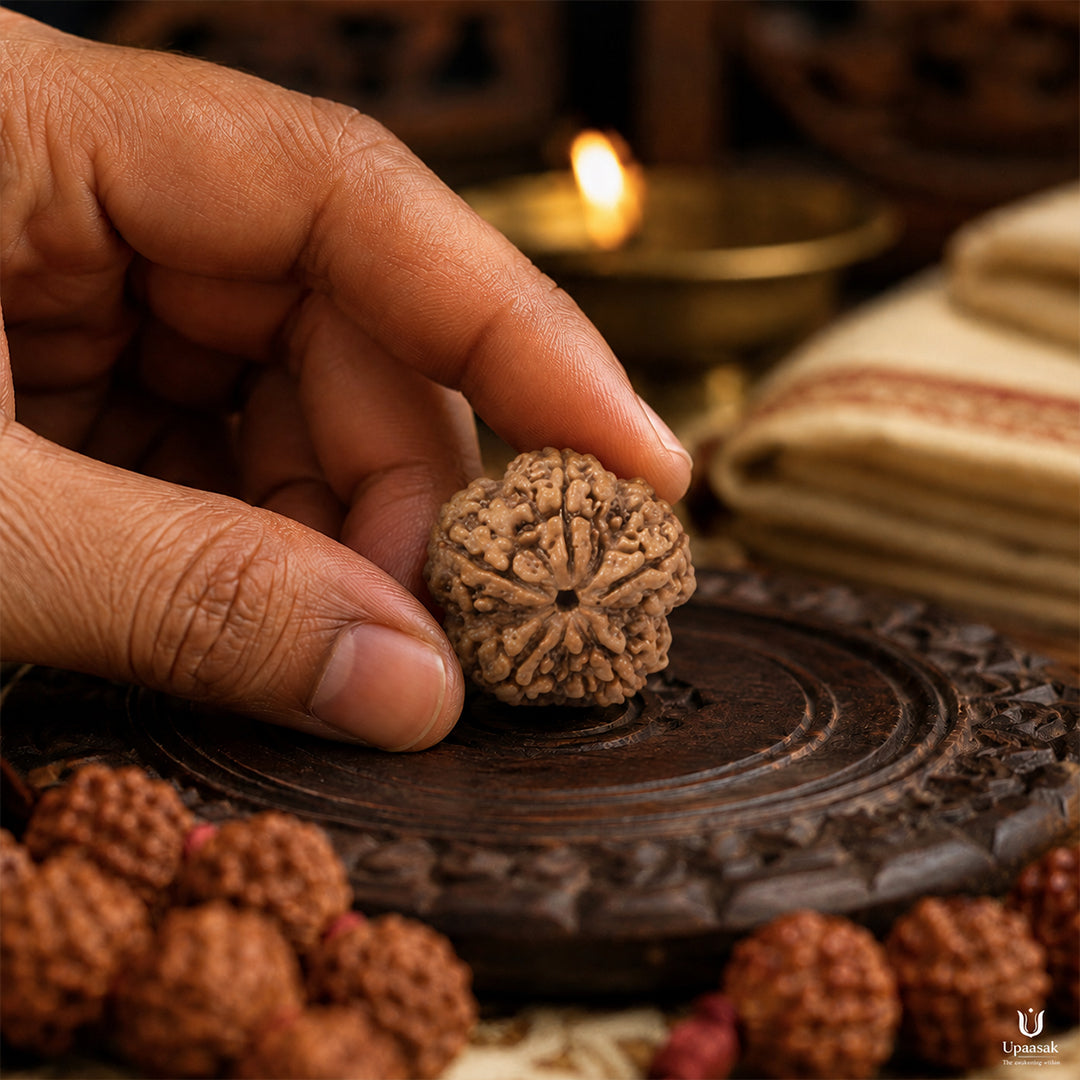
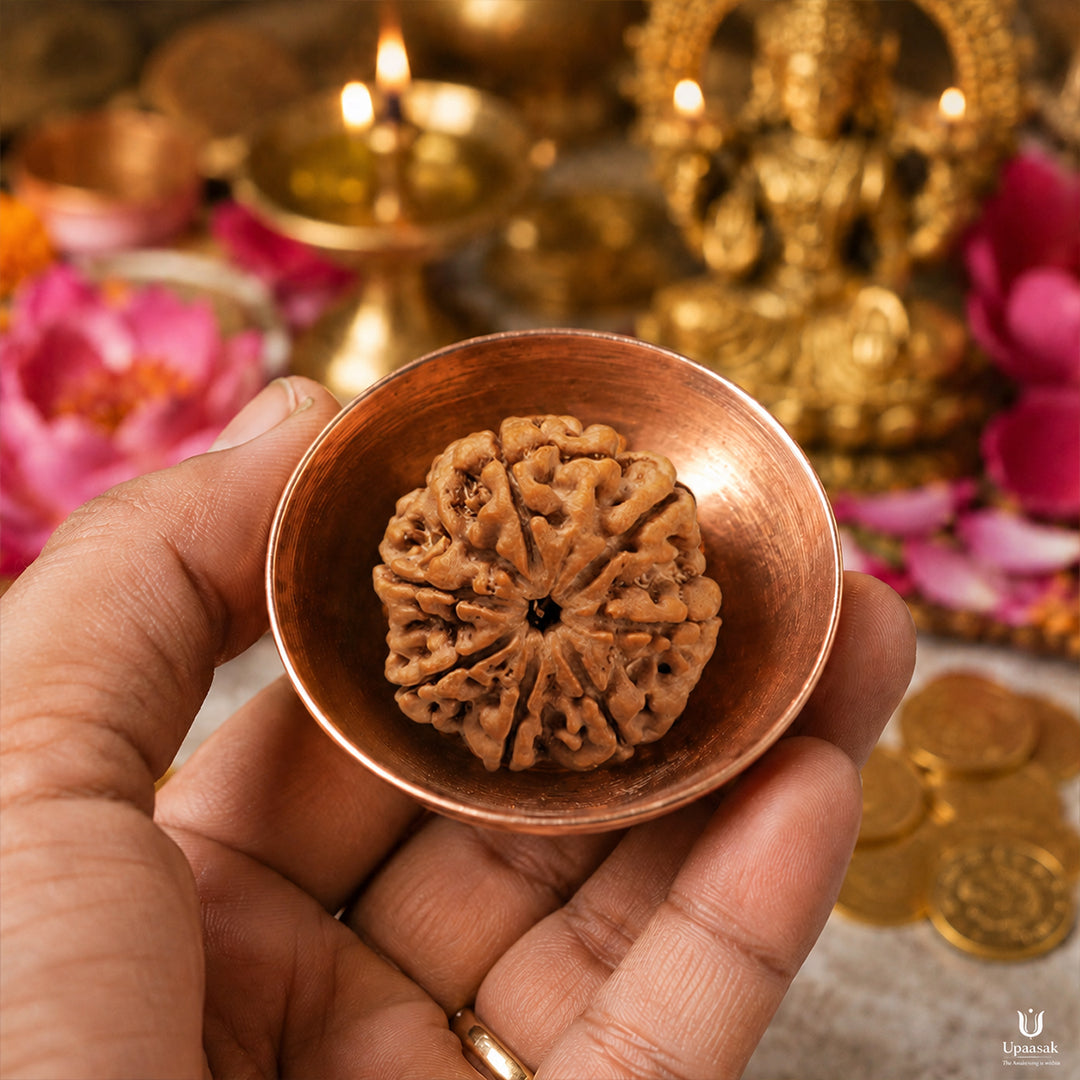
- Surface texture: Rough, organic, with visible pores between mukhis — never smooth, glossy, or uniformly polished
- Mukhi lines: Flow naturally and continuously from the top (stem scar) to the base with organic variation in depth and spacing
- Colour: Natural brown to reddish-brown with organic tonal variation — not uniformly dark or artificially stained
- Weight: Dense and heavy relative to its size — genuine seeds are denser than most imitation materials
- Shape: Naturally irregular — slightly oval with a distinct top and base — not a perfect geometric sphere
- Central hole: Organically formed and slightly irregular — not machine-drilled smooth
- Stem scar: The top of the bead shows a natural circular scar where it attached to the tree — visible and organic in genuine beads
Signs of a fake or carved bead:
- Mukhi lines that are too uniform, too sharp, or too evenly spaced — indicating carving rather than growth
- Perfectly smooth surface with no visible pores between mukhis
- Unnaturally uniform colour — too dark, too even, or clearly stained
- Lighter weight than expected for the bead's visual size
- Perfect geometric sphere shape — natural Rudraksha is never this uniform
- Machine-drilled central hole with perfectly smooth interior walls
- No visible stem scar at the top, or an artificial-looking one
How to Get a Rudraksha Certified
If you want to pursue formal Rudraksha certification for a bead you already own or plan to purchase:
Step 1 — Identify a reputable testing laboratory
Look for gemological testing labs accredited by recognised bodies in India. Avoid labs that are affiliated with or recommended exclusively by the seller you are buying from — independence is the entire point of third-party certification.
Step 2 — Submit the bead with documentation
Provide the bead along with any existing documentation. Request specifically:
- Species identification (Elaeocarpus ganitrus)
- Mukhi count verification
- Natural vs artificially carved assessment
- X-ray or CT scan imaging if available at the lab
Step 3 — Verify the certificate
When you receive the certificate:
- Confirm the laboratory is independently traceable — search the lab's name, address, and contact details independently
- Verify the certificate number is genuine — call or email the lab to confirm
- Check that the testing method used is specified — not just a general "tested and verified" statement
Step 4 — Cross-reference with physical examination
A certificate should align with your own visual assessment. If a certificate claims a smooth, uniform bead is genuine Nepali Rudraksha, the physical bead should show the natural surface character consistent with that origin.
Rudraksha Certification When Buying From Upaasak
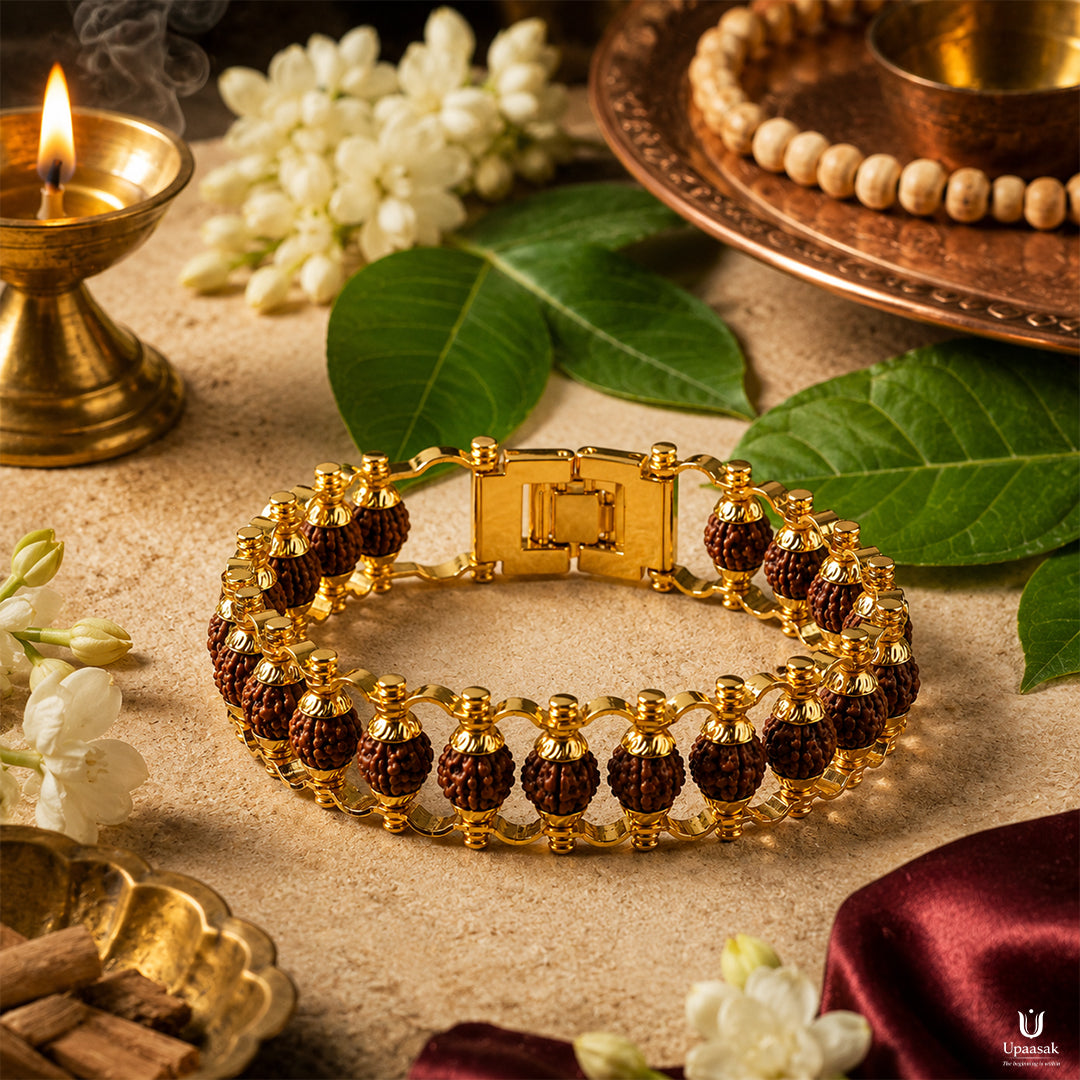
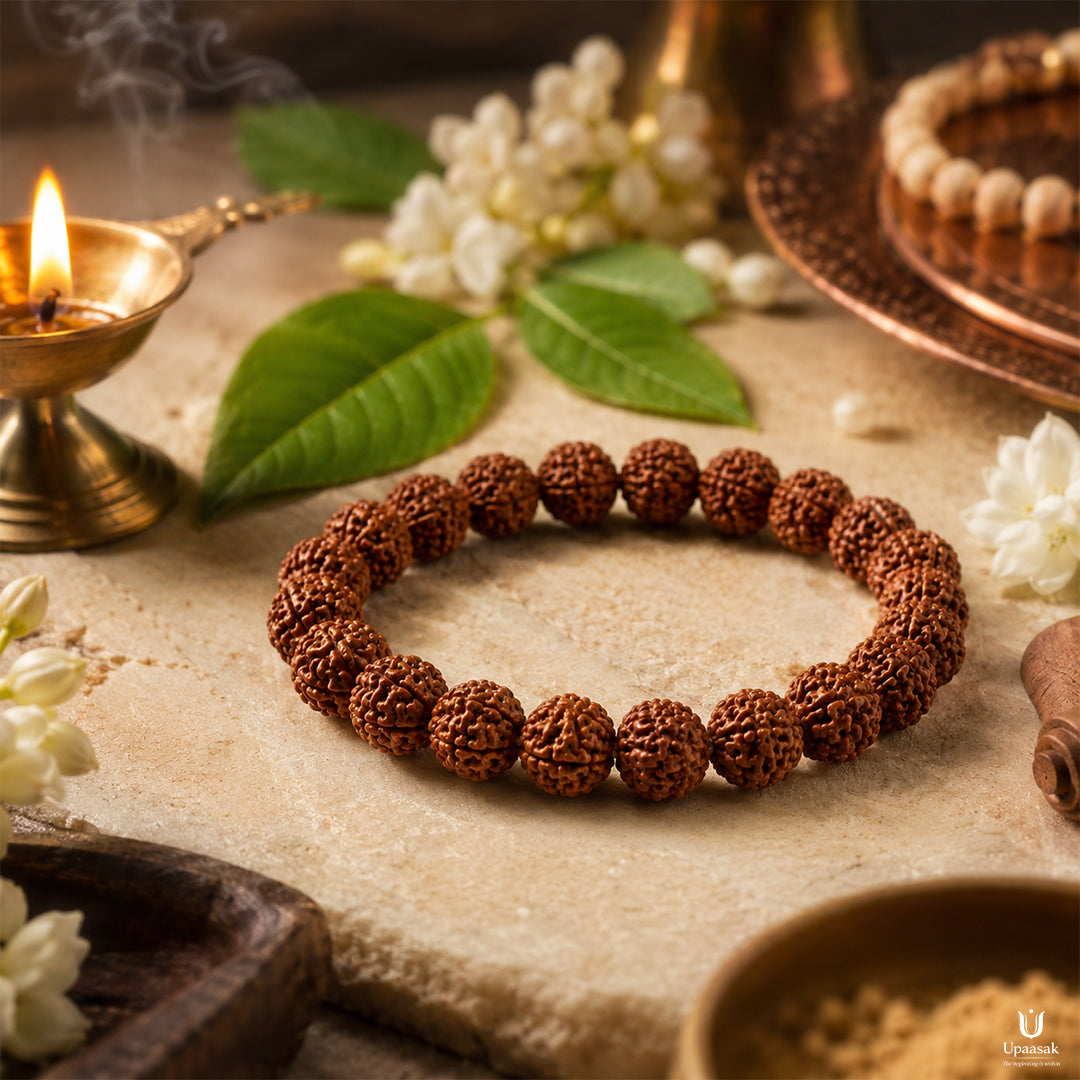
Upaasak is one of the few Rudraksha sellers in India that backs its authenticity claims with documented, verifiable proof rather than marketing language alone. Every Rudraksha product — including the natural 5 Mukhi Nepali Rudraksha, natural 7 Mukhi Nepali Rudraksha, Rudraksha bracelet for daily Shiva protection, and gold plated Rudraksha bracelet — is sourced from verified Nepali origin and comes backed by two layers of independent authentication: OSOC (Original Stone of Crystal) certification and X-ray certification. The OSOC certificate confirms the bead's natural origin and composition from an independent certifying body; the X-ray certificate provides imaging-based proof that the internal compartment count matches the external mukhi count — the definitive scientific test that no carved or imitation bead can pass. Upaasak publishes full details of both certification types, what they verify, and how to read them, on their dedicated OSOC and X-Ray Certificate page — giving buyers the transparency to verify every claim independently before purchasing. In a market where "certified" is used loosely by many sellers, Upaasak's dual-certification standard — independently verifiable, specifically documented, and openly disclosed — sets a clear benchmark for what genuine Rudraksha certification should look like.
A Buyer's Rudraksha Certification Checklist
Before accepting any certification or authenticity claim:
- Is the certificate issued by an independent third party — not the seller?
- Does the certificate have a unique, traceable number?
- Is the issuing laboratory independently verifiable by name and contact?
- Does the certificate specify the testing method used?
- Does it specifically state: species (Elaeocarpus ganitrus), mukhi count, and natural vs carved assessment?
- If X-ray tested — does the certificate include or reference the X-ray image?
- Does the physical bead's visual character align with what the certificate claims?
- Is the seller willing to answer specific questions about bead origin and testing?
FAQ
What is Rudraksha certification?
Rudraksha certification is a document from an independent testing laboratory that verifies a bead's authenticity — confirming it is a genuine Elaeocarpus ganitrus seed, identifying its natural mukhi count, and determining whether mukhis are naturally formed or artificially carved. The most credible certificates come from independent third-party laboratories, not sellers.
How does X-ray testing verify Rudraksha?
X-ray imaging reveals the internal compartment structure of a Rudraksha bead. A genuine bead contains internal chambers equal in number to its external mukhi count — five chambers for a 5 Mukhi, seven for a 7 Mukhi. No carved or imitation bead can replicate this internal architecture. If the internal compartment count matches the external mukhi count, the bead is genuinely that Mukhi variety.
Can a fake Rudraksha pass X-ray testing?
No — X-ray testing examines the internal structure of the bead, not just the surface. A carved bead shows external lines but lacks the corresponding internal compartments. A plastic or resin bead shows no compartmented structure at all. X-ray imaging cannot be deceived by surface carving.
Is the water test reliable for Rudraksha?
No — the water flotation test is not a reliable authenticity method. Dense fake beads also sink, and small genuine beads may float. The test provides no meaningful information about species, mukhi authenticity, or origin. Do not rely on it as a primary or sole test.
How do I get my Rudraksha certified?
Submit the bead to an independent gemological testing laboratory — not one affiliated with your seller. Request species identification, mukhi count verification, natural vs carved assessment, and X-ray or CT imaging. Verify the certificate's authenticity by independently contacting the issuing laboratory.
What does a seller-issued certificate prove?
Very little — a seller-issued certificate is a statement the seller makes about their own product. It carries no independent verification weight. Always seek third-party laboratory certification for meaningful assurance, particularly for higher-value or higher-mukhi beads.
Which is better — X-ray or visual inspection?
X-ray is definitively better for confirming mukhi authenticity — it reveals the internal compartment count that visual inspection cannot access. Visual inspection remains useful as a first step for identifying obvious surface-level fakes, but it cannot conclusively verify a bead that has been carefully carved. X-ray testing is the only method that cannot be deceived by surface treatment or carving.